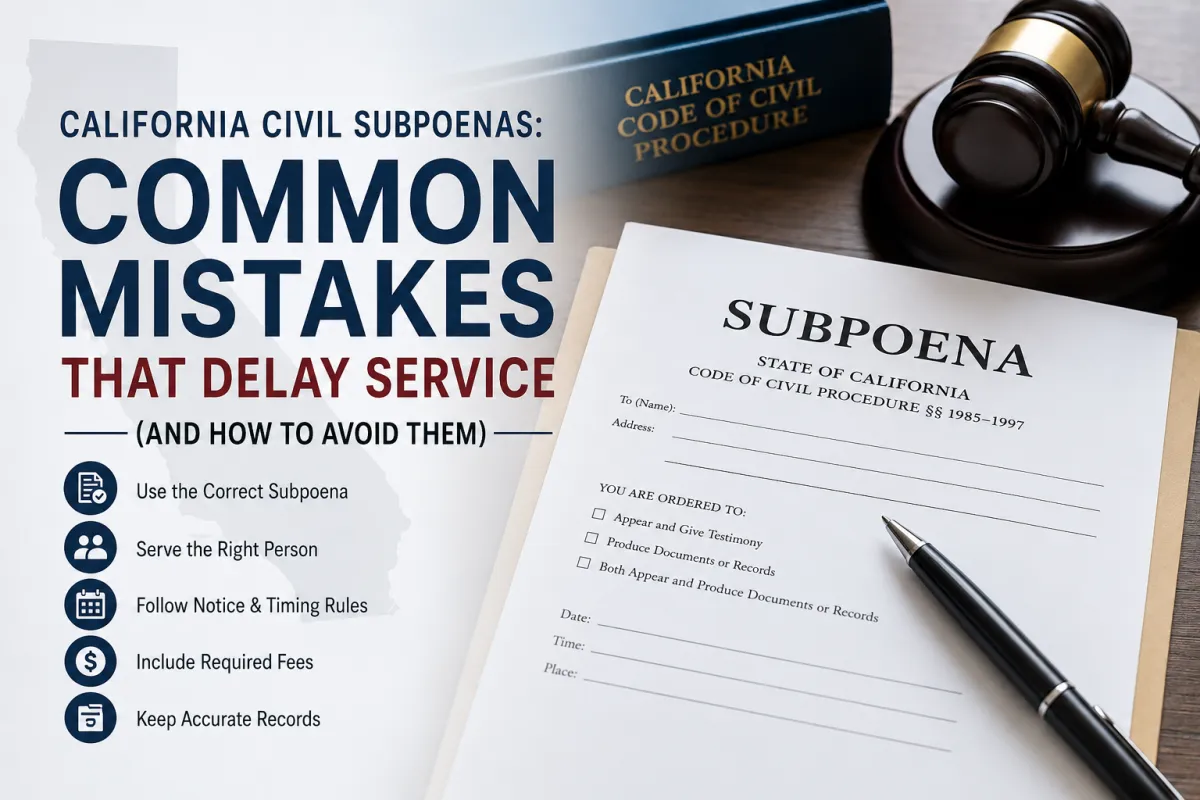
California Civil Subpoenas: Common Mistakes That Delay Service (And How to Avoid Them)
If you've ever handled litigation in California, you know that issuing a subpoena is only part of the process. A single procedural mistake—whether it's incorrect service, incomplete witness fees, or using the wrong subpoena type—can delay discovery, increase costs, and even jeopardize court deadlines.
Understanding the California subpoena process before documents are issued can help attorneys, paralegals, and legal support professionals avoid unnecessary complications and keep cases moving forward.
For a comprehensive overview of California subpoena laws, forms, and statutory requirements, you can also review our detailed guide:
"California Civil Subpoenas: A Practical Guide to CCP 1985 Through 1997."
Why Subpoena Errors Matter
California courts expect strict compliance with the California Code of Civil Procedure. Unlike ordinary discovery requests, subpoenas involve third parties who are not parties to the litigation. Because of this, procedural mistakes can result in:
Delayed production of evidence
Objections from witnesses or custodians
Motions to quash
Increased litigation expenses
Missed discovery deadlines
Additional court hearings
Most of these issues are preventable with proper planning and professional process service.
Mistake #1: Using the Wrong Type of Subpoena
California provides multiple subpoena forms, each serving a different purpose.
Examples include:
Civil Subpoena (Personal Appearance)
Deposition Subpoena for Business Records
Deposition Subpoena for Personal Records
Trial Subpoenas
Consumer Records Subpoenas
Selecting the incorrect form may invalidate the request or require re-service.
Before preparing documents, determine exactly what information is needed and who possesses it.
Mistake #2: Serving the Wrong Person
Many subpoenas—particularly those requesting business records—must be served on the proper custodian of records or authorized agent.
Common service errors include:
Serving front desk employees
Serving unauthorized staff
Delivering documents to the wrong office
Failing to identify the registered agent when required
Professional process servers often verify the correct individual before attempting service, reducing the likelihood of rejected subpoenas.
Mistake #3: Ignoring Consumer Notice Requirements
Certain subpoenas require advance notice to consumers before records may be produced.
These frequently include:
Medical records
Employment files
Financial records
Educational records
Failing to comply with California's consumer notice requirements may result in objections or motions to quash.
Proper scheduling ensures notice periods expire before production dates.
Mistake #4: Missing Witness Fee Requirements
When personal attendance is required, California law generally requires witness fees and mileage to accompany the subpoena.
A subpoena served without required statutory fees may be unenforceable.
Many litigators avoid this issue by calculating witness fees before documents are served.
Mistake #5: Waiting Until the Last Minute
Subpoenas often involve several moving parts:
Court deadlines
Consumer notice periods
Business record production timelines
Multiple service attempts
Geographic travel
Record retrieval
Waiting until days before a deposition or trial frequently creates avoidable scheduling problems.
Planning service early gives all parties adequate time to comply.
Mistake #6: Forgetting County-Specific Logistics
Although California subpoena laws apply statewide, each county presents unique logistical challenges.
For example:
High-security office buildings
Large hospital systems
Financial institutions
Government agencies
Registered agent offices
Rural service locations
Working with a statewide process serving company familiar with county-specific procedures often results in faster, more reliable service.
Mistake #7: Assuming Electronic Delivery Is Enough
Many legal professionals mistakenly assume emailing subpoena documents completes service.
In most situations, California law still requires proper statutory service methods.
Electronic communication may supplement service, but it generally does not replace legally required personal service or other authorized delivery methods.
Mistake #8: Failing to Keep Accurate Service Documentation
Detailed documentation protects everyone involved in litigation.
Good service records typically include:
Date of service
Time of service
Exact location
Identity of the recipient
Method of service
Supporting photographs when appropriate
GPS verification (when available)
Accurate proofs of service become invaluable if service is later challenged.
Best Practices for Successful California Subpoena Service
Experienced litigation teams typically follow a consistent process:
Verify the correct subpoena form.
Confirm recipient information before service.
Allow adequate time for statutory notice periods.
Include required witness fees when applicable.
Use experienced professional process servers.
Track every service attempt.
Maintain detailed proof of service records.
Coordinate document retrieval with production deadlines.
These practices significantly reduce delays while improving overall litigation efficiency.
Why Professional Process Servers Make a Difference
Serving subpoenas involves much more than delivering paperwork.
Professional process servers understand:
California procedural requirements
Service deadlines
Registered agent identification
Difficult-to-serve recipients
Business records procedures
Court filing requirements
Proof of service documentation
For law firms managing multiple cases, partnering with an experienced statewide provider can reduce administrative burdens while improving compliance.
Final Thoughts
California civil subpoenas are powerful discovery tools, but only when they are prepared and served correctly. Small procedural mistakes can lead to costly delays, objections, and additional litigation.
Whether you're requesting business records, scheduling depositions, or preparing for trial, taking the time to understand California's subpoena requirements helps ensure smoother discovery and stronger case management.
If you're looking for a deeper explanation of subpoena forms, statutory requirements, service procedures, and relevant provisions under CCP §§ 1985–1997, be sure to read our companion resource:
California Civil Subpoenas: A Practical Guide to CCP 1985 Through 1997
It provides a comprehensive reference for attorneys, paralegals, and legal professionals navigating California subpoena practice.
