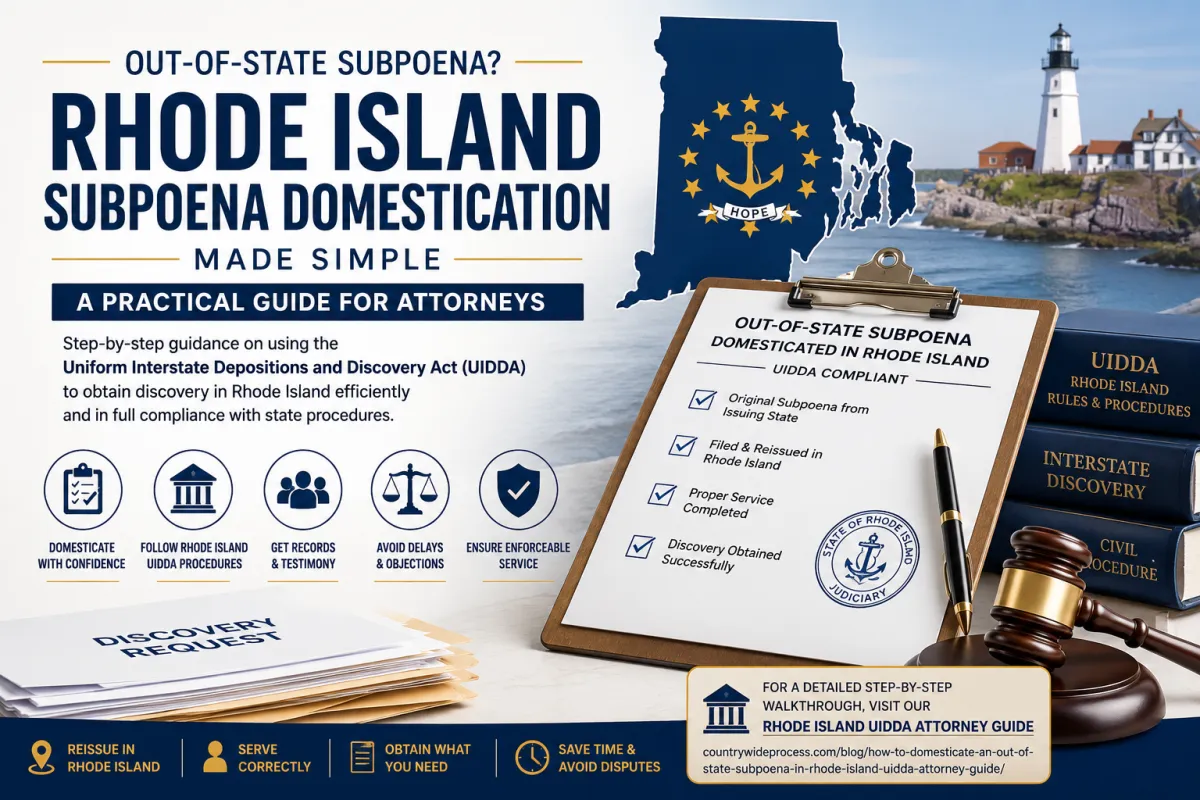
Rhode Island Out-of-State Subpoenas: A Practical Guide to UIDDA Compliance and Discovery Procedures
Cross-border litigation often requires attorneys to obtain records, testimony, or evidence located outside their home jurisdiction. When discovery targets are based in Rhode Island, legal professionals must follow the state's adoption of the Uniform Interstate Depositions and Discovery Act (UIDDA) to lawfully issue and enforce subpoenas originating from another state.
This guide explains how Rhode Island handles foreign subpoenas, outlines the domestication procedure, and highlights the practical considerations attorneys should understand before serving discovery requests within the state.
Understanding Rhode Island’s UIDDA Framework
Rhode Island follows the Uniform Interstate Depositions and Discovery Act, allowing attorneys from participating states to conduct discovery in Rhode Island without opening a separate lawsuit. Instead of filing a full ancillary action, litigants can submit the subpoena issued in their original case to the appropriate Rhode Island authority for reissuance.
The process simplifies interstate discovery while ensuring Rhode Island witnesses and businesses remain protected under local procedural rules.
Under this framework, the subpoena issued in the originating jurisdiction is converted into a Rhode Island subpoena that complies with local service and enforcement requirements.
When Rhode Island Subpoena Domestication Is Necessary
Domestication is typically required whenever a witness, records custodian, healthcare provider, employer, or corporation located in Rhode Island receives a subpoena connected to litigation pending in another state.
Common examples include:
Medical record requests
Banking and financial document subpoenas
Employment and payroll records
Depositions of Rhode Island witnesses
Corporate document production
Insurance claim file requests
Electronically stored information (ESI)
If the recipient resides or conducts business in Rhode Island, attorneys generally cannot directly serve a foreign subpoena without first completing the UIDDA domestication procedure.
The Basic Rhode Island UIDDA Process
Although procedural details can vary by county or clerk’s office, the standard process generally includes the following steps:
1. Obtain the Original Foreign Subpoena
The subpoena must first be properly issued in the trial state where the litigation is pending. It should clearly identify the requested records, testimony, or inspection requirements.
2. Prepare Rhode Island-Compliant Documents
The foreign subpoena is then submitted alongside any required Rhode Island forms or cover materials necessary for issuance under local rules.
Attorneys should carefully verify:
Caption formatting
Witness information
Discovery scope
Production deadlines
Deposition location details
Compliance with Rhode Island procedural standards
3. Issue the Rhode Island Subpoena
Once accepted, the subpoena is formally issued for use within Rhode Island jurisdiction.
This newly issued subpoena becomes enforceable under Rhode Island law.
4. Serve the Witness or Custodian
After issuance, the subpoena must be served according to Rhode Island service requirements. Professional process servers are commonly used to ensure valid delivery and proper documentation.
For attorneys seeking additional procedural guidance on interstate subpoena compliance in Rhode Island, review this detailed Rhode Island UIDDA attorney guide covering subpoena domestication requirements, filing procedures, and service considerations.
Why Precision Matters in Interstate Discovery
One of the most common causes of delay in interstate subpoena work is vague or overly broad document language. Requests lacking specificity can trigger objections, compliance delays, or motions to quash.
Effective subpoena drafting should clearly identify:
Relevant date ranges
Names of individuals or entities
Exact categories of records
Requested electronic formats
Production instructions
The more precise the request, the smoother the compliance process usually becomes.
Depositions and Remote Testimony Considerations
Rhode Island subpoenas may also compel witness testimony for depositions. Depending on the circumstances, attorneys may coordinate:
In-person depositions
Zoom or remote testimony
Hybrid deposition arrangements
Third-party deposition officer services
Scheduling flexibility has become increasingly important as remote discovery practices continue expanding across multi-state litigation.
Service Timing and Compliance Issues
Attorneys handling interstate subpoenas should avoid compressed production schedules. Short turnaround times often create unnecessary disputes with records custodians or opposing counsel.
Additional timing considerations may apply when subpoenas involve:
Consumer records
Medical privacy laws
Employment files
HIPAA authorizations
Financial account information
Proper notice procedures should always be reviewed before service.
Enforcement and Objections
Once domesticated, Rhode Island courts maintain authority over subpoena enforcement disputes occurring within the state. Witnesses or businesses may object if:
The request is overly burdensome
Privileged information is requested
Notice requirements were not satisfied
The subpoena exceeds permissible discovery limits
Courts may modify, limit, or quash subpoenas that fail to comply with Rhode Island procedural standards.
Working With Experienced Process Servers
Because interstate discovery often involves strict deadlines and procedural technicalities, many law firms rely on professional subpoena service providers familiar with Rhode Island filing and service requirements.
Experienced process servers can assist with:
UIDDA domestication coordination
Court filing procedures
Records subpoena delivery
Deposition witness service
Affidavits of service
Rush and same-day assignments
This reduces administrative delays and helps ensure enforceable service.
Final Thoughts
Interstate discovery in Rhode Island becomes significantly more manageable when attorneys understand the UIDDA domestication process and local procedural expectations. Proper drafting, accurate timing, and compliant service remain essential for avoiding objections and securing timely evidence production.
As multi-state litigation continues increasing, Rhode Island’s UIDDA framework provides a streamlined pathway for obtaining testimony and records without initiating separate legal actions inside the state.
Source Reference
This article was independently written for educational purposes using publicly available legal concepts related to Rhode Island interstate subpoena procedures. Additional procedural insights and reference material were reviewed from:
Rhode Island UIDDA Attorney Guide published by Countrywide Process.
