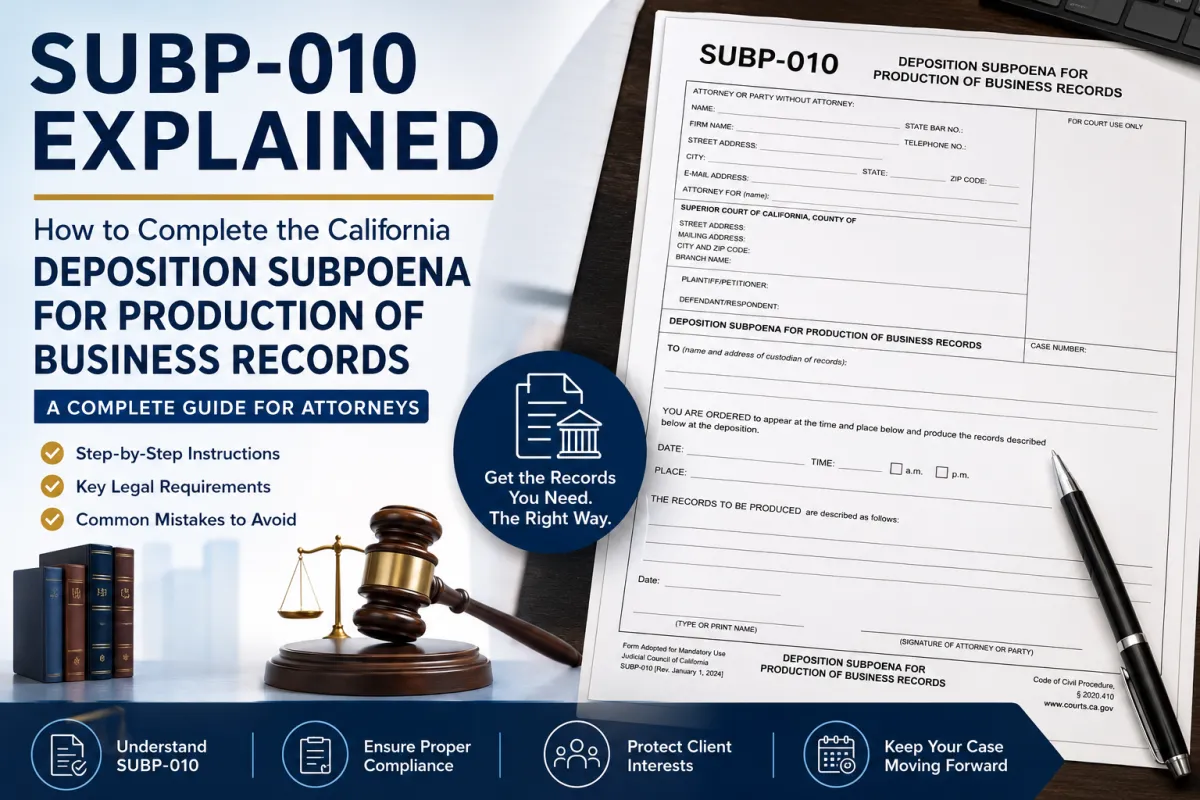
SUBP-010 Explained: A Complete Guide to California's Deposition Subpoena for Production of Business Records
SUBP-010 Explained: A Complete Guide to California's Deposition Subpoena for Production of Business Records
Discovery is one of the most important stages of any civil lawsuit. Long before a case reaches trial, attorneys spend considerable time collecting documents, interviewing witnesses, and obtaining evidence that supports their client's claims or defenses. While parties to a lawsuit are generally required to exchange relevant information with each other, many of the most valuable records are often held by businesses or organizations that are not directly involved in the litigation.
Medical providers maintain treatment records. Banks retain financial statements and transaction histories. Employers keep payroll records and personnel files. Insurance companies preserve claims documentation, while telecommunications companies store account information and communication records. When these documents become relevant to a legal dispute, California law provides a mechanism for obtaining them through Form SUBP-010, officially titled the Deposition Subpoena for Production of Business Records.
Although the form itself is only a few pages long, successfully using it requires much more than simply filling in blank spaces. California's discovery statutes contain detailed rules governing notice requirements, privacy protections, service procedures, production deadlines, and consumer rights. Missing a required step can delay discovery, increase litigation costs, or even result in the subpoena being challenged before the court.
This comprehensive guide explains what SUBP-010 is, when it should be used, how to complete it correctly, common mistakes to avoid, and why professional process serving plays an important role in ensuring compliance with California law.
Disclaimer: This article is intended for educational purposes only and should not be considered legal advice. Attorneys and litigants should review the applicable California Code of Civil Procedure and local court rules for their specific matter.
What Is California Form SUBP-010?
California Form SUBP-010 is the Judicial Council form used to request business records from a non-party during the discovery phase of litigation. Unlike subpoenas that require an individual to appear in court or testify at a deposition, this form is designed specifically for obtaining documents and electronically stored information from businesses that possess records relevant to a case.
The subpoena is directed to the Custodian of Records, who is the individual or department responsible for maintaining the organization's official records. Rather than appearing personally, the custodian generally satisfies the subpoena by producing certified copies of the requested documents through a designated deposition officer.
Business records often serve as objective evidence because they are created and maintained during the normal course of business rather than specifically for litigation. Courts frequently rely on these records to establish facts such as medical treatment, employment history, financial transactions, contractual obligations, insurance coverage, and ownership interests.
Because business records can significantly influence the outcome of a lawsuit, California law establishes procedures intended to balance the need for discovery with the privacy rights of individuals and businesses. Properly preparing and serving SUBP-010 helps ensure that evidence is obtained lawfully while minimizing unnecessary disputes.
When Should SUBP-010 Be Used?
SUBP-010 is appropriate whenever documents need to be obtained from an individual or organization that is not a party to the lawsuit. Instead of requesting testimony, the subpoena seeks the production of existing records that are relevant to the issues in dispute.
For example, in a personal injury lawsuit, an attorney may need medical records from a treating physician to establish the nature and extent of the plaintiff's injuries. In an employment dispute, payroll records may be necessary to calculate lost wages or verify periods of employment. A breach of contract case may require invoices, purchase orders, or accounting records maintained by a third-party vendor.
Financial institutions are another common recipient of business records subpoenas. Bank statements, loan applications, wire transfer records, and account histories can all become relevant depending on the issues involved in the litigation. Likewise, insurance companies may receive subpoenas requesting claims files, policy information, or communications relating to an insurance dispute.
The key requirement is that the records must be reasonably calculated to lead to the discovery of admissible evidence. California discovery rules are broad, but they are not unlimited. Requests should remain relevant, proportional, and tailored to the needs of the case.
Understanding the Purpose of Business Records Discovery
One of the primary goals of discovery is to prevent surprises during trial. By allowing each side to obtain relevant documents before a hearing or trial begins, the legal process becomes more transparent and efficient.
Business records often provide evidence that cannot easily be disputed because they are maintained independently of the parties involved in the lawsuit. Medical charts document treatment provided months or years before litigation began. Payroll systems automatically calculate earnings. Banking software records financial transactions as they occur. These documents frequently carry substantial evidentiary value because they were created during the ordinary course of business.
Obtaining these records early also allows attorneys to evaluate the strengths and weaknesses of their cases. Evidence gathered through subpoenas often influences settlement negotiations, expert witness opinions, mediation strategies, and trial preparation. In many cases, the production of business records resolves factual disputes long before the case reaches a courtroom.
How to Complete California Form SUBP-010
Although the form appears relatively simple, each section serves a specific legal purpose. Careful attention to detail reduces the likelihood of objections and helps ensure timely production of the requested documents.
The first section requires the complete court information, including the name of the court, the parties to the lawsuit, and the assigned case number. This information should exactly match the filed pleadings to avoid confusion or administrative delays.
The subpoena must then identify the business receiving the request. It is important to use the correct legal name of the organization and direct the subpoena to the Custodian of Records whenever appropriate. Large corporations often have centralized records departments, while smaller businesses may designate a specific office manager or administrator to handle subpoena requests.
Perhaps the most important portion of the form is the description of the records being requested. Attorneys should avoid vague requests such as "all documents" whenever possible. Instead, requests should clearly describe the categories of records sought, applicable date ranges, account numbers, claim numbers, patient names, employee names, or other identifying information.
Providing detailed descriptions benefits everyone involved. Businesses can locate responsive records more efficiently, deposition officers can process productions more accurately, and disputes over overly broad requests are less likely to arise.
Consumer Notice Requirements Under California Law
One of the most frequently overlooked aspects of business records subpoenas involves California's consumer notice requirements. Certain records are protected by privacy laws because they contain highly personal information belonging to individuals.
Medical records, employment records, financial records, educational records, and similar documents generally require advance notice to the affected consumer before production can occur. This notice provides an opportunity for the consumer to object or seek court intervention if appropriate.
Failure to follow these notice procedures may prevent the records from being produced even if the subpoena itself is otherwise completed correctly. For this reason, attorneys often prepare consumer notices simultaneously with the subpoena to ensure all statutory requirements are satisfied.
Because privacy laws continue to evolve alongside technological advances, careful attention to notice requirements remains an essential part of modern discovery practice.
Electronic Records and Modern Discovery
Business records are no longer limited to paper files stored in filing cabinets. Today's organizations maintain enormous amounts of information electronically, including emails, spreadsheets, databases, digital contracts, scanned documents, cloud storage, surveillance footage, and electronic accounting systems.
California discovery rules recognize the growing importance of electronically stored information (ESI). Depending on the circumstances, a properly drafted subpoena may request electronic documents in their native format or as searchable PDF files.
When requesting electronic records, clarity is especially important. Attorneys should specify the types of files sought, relevant custodians, date ranges, and preferred production formats whenever appropriate. Well-defined requests reduce confusion while minimizing unnecessary collection costs for the responding business.
As technology continues to change, understanding electronic discovery has become an increasingly valuable skill for litigators handling complex civil cases.
Serving the SUBP-010 Correctly
Completing the subpoena is only one part of the process. Proper service is equally important because California law establishes detailed rules governing how subpoenas must be delivered.
Professional process servers understand these procedural requirements and help ensure that documents are served on the appropriate individual or department. They also prepare accurate proofs of service that may later become important if service is challenged.
Large organizations often maintain registered subpoena intake departments or legal compliance offices. Experienced process servers know how to identify the proper recipient, reducing delays caused by serving the wrong office or individual.
Using a knowledgeable statewide process serving company can be particularly valuable when subpoenas must be served in multiple California counties within tight litigation deadlines.
Common Mistakes That Delay Business Records Production
Many subpoena-related delays result from preventable errors rather than disputes over the requested information itself.
One common mistake is requesting records that are overly broad or insufficiently described. Businesses cannot reasonably determine what documents are responsive if the request lacks specificity.
Another frequent issue involves incorrect business names or outdated addresses. Serving the wrong entity may require the subpoena to be reissued and served again, resulting in unnecessary expense and lost time.
Attorneys should also verify production dates carefully. Selecting unrealistic deadlines may create compliance problems, especially when large volumes of records must be collected and reviewed.
Perhaps the most significant procedural error involves failing to comply with applicable consumer notice requirements. Because many business records contain confidential information, overlooking these protections can halt production entirely until notice issues are resolved.
Careful preparation and experienced litigation support significantly reduce the likelihood of these problems.
Can a Business Object to a SUBP-010?
Yes. Businesses, consumers, or other interested parties may challenge a subpoena under appropriate circumstances.
Objections often arise when requests are excessively broad, seek privileged information, impose an unreasonable burden, or fail to comply with procedural requirements. Privacy concerns may also justify objections, particularly when highly confidential information is involved.
In some cases, parties may negotiate a narrower scope of production rather than pursuing court intervention. Limiting requests to relevant time periods or specific categories of documents often resolves disputes without delaying discovery.
Preparing focused, well-supported subpoenas from the outset remains one of the most effective ways to minimize objections.
Best Practices for Attorneys and Legal Professionals
Successful subpoena practice begins with thoughtful planning rather than simply completing a form. Before preparing SUBP-010, attorneys should identify precisely which records are needed and why those records are relevant to the issues in dispute.
Requests should remain proportional to the needs of the litigation and avoid unnecessary fishing expeditions. Narrowly tailored subpoenas are generally easier for businesses to comply with and less likely to generate objections.
Maintaining communication with deposition officers and process servers also improves efficiency. Tracking service dates, production deadlines, and follow-up correspondence helps ensure discovery progresses without avoidable interruptions.
Finally, attorneys should remain mindful that business records often contain confidential information. Appropriate protective orders or confidentiality agreements may be necessary depending on the nature of the documents requested.
How Countrywide Process Supports California Law Firms
Successfully obtaining business records requires more than simply preparing paperwork. It requires accurate service, careful attention to procedural rules, timely communication, and dependable litigation support.
Countrywide Process assists attorneys, corporations, government agencies, and self-represented litigants throughout California with professional process serving and subpoena support. Our experienced team understands the importance of accuracy, timely service, and responsive communication when litigation deadlines matter.
Whether your firm needs a single business records subpoena served or coordinated statewide subpoena services across multiple counties, Countrywide Process provides reliable support designed to help keep discovery moving efficiently.
Frequently Asked Questions
Is SUBP-010 used only in civil cases?
Yes. SUBP-010 is generally used during civil discovery proceedings to obtain business records from non-party organizations.
Can electronic records be requested?
Yes. Businesses may produce electronically stored information when appropriately requested and maintained in the ordinary course of business.
Does the custodian of records usually have to appear personally?
In many situations, certified copies of the requested records satisfy the subpoena without requiring personal testimony.
Can a subpoena request medical records?
Yes, although additional consumer notice requirements and privacy protections generally apply before production.
What happens if the subpoena contains errors?
Mistakes may delay production, require corrective action, or result in objections from the responding business or affected consumer.
Can businesses charge for producing records?
California law permits businesses to recover certain reasonable costs associated with locating, copying, and producing records as provided by applicable statutes.
Should attorneys use a professional process server?
Professional process servers help ensure subpoenas are served correctly, proofs of service are properly completed, and litigation deadlines are met efficiently.
Final Thoughts
California Form SUBP-010 remains one of the most important discovery tools available to attorneys seeking documentary evidence from third-party businesses. Although the form itself appears straightforward, successful use requires careful attention to procedural rules, consumer privacy protections, accurate drafting, and proper service.
A well-prepared subpoena not only increases the likelihood of timely document production but also minimizes objections, reduces litigation delays, and supports a more efficient discovery process. As business records continue to expand beyond traditional paper files into electronic and cloud-based systems, understanding how to properly request and obtain these records has become an essential skill for today's legal professionals.
Whether you are requesting medical records, employment files, financial documents, insurance claims, or corporate records, working with an experienced litigation support provider can help ensure that every step of the subpoena process is handled accurately and professionally.
Need assistance serving a California business records subpoena? Contact Countrywide Process for dependable statewide process serving, subpoena support, court filing, skip tracing, and litigation support services trusted by attorneys throughout California.
